"Bonnie Honig invigorates debate over the politics of refusal by insisting that withdrawal from unjust political systems be matched with collective action to change them. Historical and fictional characters from Muhammad Ali to the Bacchants of ancient Greek tragedy teach us how…
"From one of America's most inspiring political leaders, a book about the core truths that unite us, and the long struggle to discern what those truths are and how best to act upon them, in her own life and across the life of our country. By reckoning with the big challenges we …
After retracing the genesis of the politics of punishment and pardon after 1945 and analyzing the construction of the idea of transitional justice and its rise in power, three case studies are presented putting transitional justice to the test. Examined are the limits, contradic…
"This volume explores the continuous line from informal and unrecorded practices all the way up to illegal and criminal practices, performed and reproduced by both individuals and organisations. The authors classify them as alternative, subversive forms of governance performed b…
Transparency is a fundamental principle of justice. A cornerstone of the rule of law, it allows for public engagement and for democratic control of the decisions and actions of both the judiciary and the justice authorities. This book looks at the question of transparency within…
This book looks at the question of transparency within the framework of transitional justice. The collection analyses the issue from socio-legal, cultural studies and practitioner perspectives. Taking a three-part approach, it firstly discusses basic principles guiding justice g…
Transparency is a fundamental principle of justice. A cornerstone of the rule of law, it allows for public engagement and for democratic control of the decisions and actions of both the judiciary and the justice authorities. This book looks at the question of transparency within…
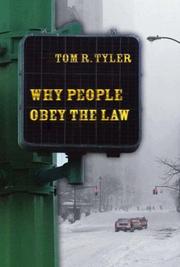
Tyler conducted a longitudinal study of 1,575 Chicago inhabitants to determine why people obey the law. His findings show that the law is obeyed primarily because people believe in respecting legitimate authority, not because they fear punishment. The author concludes that lawma…
"People obey the law if they believe it's legitimate, not because they fear punishment--this is the startling conclusion of Tom Tyler's classic study. Tyler suggests that lawmakers and law enforcers would do much better to make legal systems worthy of respect than to try to inst…
Based on a survey conducted in Chicago that sought to identify factors contributing to respect for and compliance with the law and legal authorities, Tyler challenges many of the assumptions about why people obey the law. He rejects the instrumental view that people obey the law…
Rebel Courts presents an argument that it is possible for non-state armed groups in situations of armed conflict to legally establish and operate a system of courts to administer justice. Neither the concept of the rule of law nor the general principle of state sovereignty stand…