
Discusses research in "small-worlds" theory, which contends that networks, whether they be social or biological, interact according to a set pattern; and examines the theory's application to such topics as the global economy and the Human Genome Project
"77" Result
Sort By:


""If you ever wanted to know how many links connect you and the Pope, or why when the U.S. Federal Reserve Bank sneezes the global economy catches cold, read this book," writes John L. Casti. This "cogent and engaging" (Nature) work presents the fundamental principles of the eme…
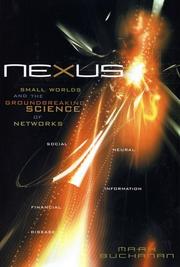
Discusses research in "small-worlds" theory, which contends that networks, whether they be social or biological, interact according to a set pattern; and examines the theory's application to such topics as the global economy and the Human Genome Project.


This Lecture Notes Volume represents the first time any of the summer school lectures have been collected and published on a discrete subject rather than grouping all of a season's lectures together. This volume provides a broad survey of current thought on the problem of patter…


Composers have used formalized procedures to create music throughout history. With the advent of the computer, algorithmic composition allows composers not only to create and experiment with different formalisms, but to hear and evaluate results quickly. Often in algorithmic com…


Composers have used formalized procedures to create music throughout history. With the advent of the computer, algorithmic composition allows composers not only to create and experiment with different formalisms, but to hear and evaluate results quickly. Often in algorithmic com…


Philip Ball explores the science of the branching patterns we see in nature, revealing that there is much more to these networks than meets the eye. He explains how there are hidden rules at work that can give us extraordinary insights into the nature of life itself.

"As part of a trilogy of books exploring the science of patterns in nature, acclaimed science writer Philip Ball here looks at the form and growth of branching networks in the natural world, and what we can learn from them. Many patterns in nature show a branching form - trees, …

Philip Ball explores the science of the shapes we see in nature, revealing how there is a pattern-forming tendency in the basic processes of nature, and from a few simple themes, and the repetition of simple rules, endless beautiful variations can arise.


Philip Ball explores the science of the branching patterns we see in nature, revealing that there is much more to these networks than meets the eye. Whether trees, snowflakes, forked lightning, or systems of arteries and veins, he explains how there are hidden rules at work that…

Reveals how recurring patterns in nature are accounted for by a single governing principle of physics, explaining how all designs in the world from biological life to inanimate systems evolve in a sequence of ever-improving designs that facilitate flow.